August 10, 2022 by
VP DAY SERVICE
VP (Victory in the Pacific) Day, also referred to as VJ (Victory over Japan) Day, is commemorated on 15 August. This date commemorates Japan’s acceptance of the Allied demand for unconditional surrender 14 August 1945. For Australians, it meant that the Second World War was finally over.
VP Day Commemorative Service
15th August
Time: 10:30am – Guests Assemble
11:00am – Service Commences
Venue: Cenotaph at Kedron Wavell Ltd (Club), Kittyhawk Drive Chermside
April 20, 2018 by
2025 Committee Members
President: Ken Roma
Snr Vice President: Greg Peake OAM
Jnr Vice President: Barry Kyrwood
Treasurer: David Izatt
Committee/Sub Committee
John Lunn, John O’Brien, Colin Randle, Greg Russell, Rod Sellin, Alan Walker
Non-Committee Members:
Secretary: Lesley Quirke
Asst. Treasurer: Rhonda Grove
March 2, 2018 by
Kedron Wavell Women’s Auxiliary
 https://kwrsl.org.au/affiliations/
THE KEDRON-WAVELL SUB BRANCH WOMEN’S AUXILIARY
The KWRSL Women’s Auxiliary provide support to the Sub Branch and the Veteran Community meeting every Thursday morning at Kedron Wavell Ltd, 21 Kittyhawk Drive Chermside for social activites. For further information concerning the Women’s Auxiliary, contact Carmel Gould, the Women’s Auxiliary President at the Sub Branch on (07) 3359 0460.
March 2, 2018 by Leave a Comment
Kedron Wavell Ex-Servicewomen’s Association
 Kedron Wavell Ex-Servicewomen’s Association
Sadly the Kedron Wavell Ex-Servicewomen’s Association has folded.
May 21, 2017 by
ANZAC – Speech by Jedidiah Fesolai
Each year, on the 25th of April, we commemorate and honour the sacrifices of those who have laid down their lives in service to our country. Today, most importantly, we remember those Australian and New Zealand volunteer soldiers, who landed on the battle-stricken sands of Gallipoli – what is now called ANZAC cove, almost 103 years ago. We admire the countless sacrifices of past and current service men and women, for our sovereign common-wealth.
Lest we forget.
World War 1 was a war originating in Europe that lasted from 28 July 1914 to 11 November 1918. Over 500,000 Australian and New Zealand troops were mobilised, and were shipped off to assist in the western front, in Europe. With Turkey allying with Germany, this opened up a new opportunity for the Allied forces to weaken the expansion of the German invasion, and to establish a new front through the east. This campaign was intended to force Germany’s ally, Turkey, out of the war. The campaign began with an attempt to force their way through the Gallipoli Peninsula in the Dardanelles, by naval power alone but early bombardments on the coastal ports failed. In light of this event, the Mediterranean Expeditionary Forces comprised of British, Indian, French, Australian and New Zealand forces, with members 70,000 strong, were to use a different method as opposed to naval warfare, a full frontal assault. 30,000 of these men, were courageous ANZAC’s.
Before dawn on Sunday 25 April 1915, the first three battleships carrying the first wave of Australians had reached the coast near the Gaba Tepe headland. The expected result was a swift take-over of the beach at Gallipoli, but a combination of unexpectedly hostile terrain and ferocious Turkish defence soon stopped any potential advance and the campaign degenerated into the familiar deadlock of trench warfare.
The day of the landing saw some of the most terrible fighting of the whole Gallipoli Campaign. When officers fell to Turkish bullets, small parties of Australians pushed inland, and fought and died where they stood. Some men were able to reach the third ridge, and others climbed the summit of the height called ‘Baby 700’. However, they were overwhelmed by Turkish attacks.
By the end of the first day, the Australians were relentlessly holding the ragged crests of First Ridge, digging trenches to await the inevitable counter-attacks, while the air sang with the whine and crack of bullets, machine gun fire and shells. By the day’s end, 3000 Australian soldiers were killed or injured, and their beach-head was barely one kilometre deep, instead of the expected seven.
This battle lasted eight months and would be etched forever in our minds. Perhaps the battle that best portrayed the true ANZAC spirit, is one often referred to as, “The Battle of Anzac”. At 3am, on the morning of 19 May, 1915, there were barely 17,000 Anzac troops at Anzac Cove, when they were suddenly attacked by an army of 42,000 Turkish soldiers. After hours of struggle, 10,000 Turkish soldiers had fallen, and a majority of them lay dead and dying in ‘No Man’s Land’. Compared to this, the Anzac casualties were only 628 men. As the days went past, the cries of the wounded Turkish soldiers moved the hearts of the Australian soldiers to pity. These Anzacs were moved by the bravery and courage of the Turkish soldiers. On that day, they arranged a truce, and the Anzacs helped the Turkish bury the dead. This act of kindness would change the attitudes of both sides, acknowledging that above being soldiers, they were still people.
Despite the eight months of tireless fighting, and conflict, the Anzacs held on to their humanity in a world that seemed to resent it. Their bravery and courage, was only matched by the kindness and compassion they were capable of. Let us remember them not only as soldiers, but as the very foundations of this sovereign and free nation we live in today.
Lest We Forget!
Jedidiah Fesolai
August 10, 2015 by
Lest we forget…
On this day in 1914 Volunteer recruiting began in Australia. By the end of 1914 52,561 Australian volunteers passed the strict physical and medical standards for overseas service.
June 22, 2015 by
WORLD WAR I UNIFORMS and what they mean

Uniform – Australian Light Horse 1914-1918
Our Sub Branch is proud to be able to display an original uniform worn by one of the mounted soldiers of the Australian Light Horse 1914-1918.
The distinctive uniform is instantly recognisable beginning with the famous Australian slouch hat adorned with badge, chinstrap, hatband and feathers. The Service Dress jacket (complete with buttons and badges) was worn with riding breeches. The dress jacket was secured with a Leather belt with leather pouches 2×10 round & 2×15 round.
This particular uniform also comprises of a haversack with shoulder strap, a water bottle with leather carrier and shoulder strap. The distinctive Light Horse Bandolier (some of which carried up to 90 r0unds of ammunition) has 9xpouches for Cal .303-in ammunition. The uniform is completed with leather leggings (Stowassar Pattern), and dark tan leather boots.
The Sub Branch was successful in securing the purchase of this uniform. You will see this uniform proudly displayed in a cabinet to the left hand side as you ride the Services Club escalator to the first floor of the Services Club.
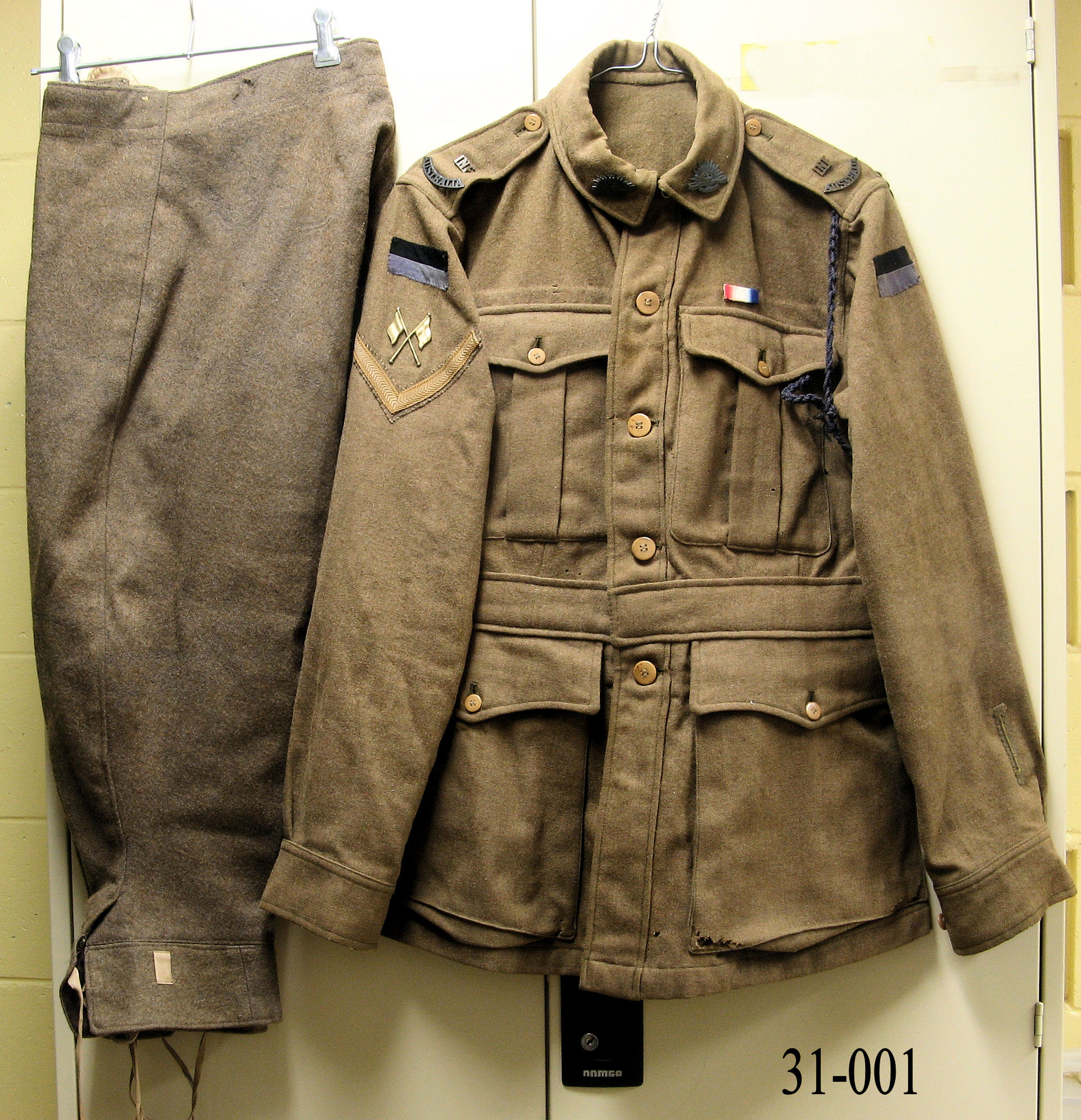
Service Dress Jacket and Jodhpurs Army, WWI
Further, as part of the Sub Branch’s World War I uniform collection, a uniform tunic known as the “jacket service dress” worn by the Australian Imperial Force (AIF) with khaki cord breeches is also displayed. This jacket service dress would have been worn over a soft grey collarless flannel shirt and underclothes consisting of a vest and drawers.
(By way of background, the Australian War Memorial records show that the 9th Battalion was among the first infantry units raised for the AIF during the First World War. It was the first battalion recruited in Queensland, and with the 10th, 11th and 12th Battalions it formed the 3rd Brigade.
The battalion was raised within weeks of the declaration of war in August 1914 and embarked just two months later. After preliminary training, the battalion sailed to Egypt, arriving in early December. The 3rd Brigade was the covering force for the ANZAC landing on 25 April 1915, and so was the first ashore at around 4.30 am. The battalion was heavily involved in establishing and defending the front line of the ANZAC beachhead. It served at ANZAC until the evacuation in December 1915.)
This particular jacket service dress displays the rank insignia of a Lance Corporal, Signaller. The colour patch denotes this uniform as having being worn by a 9th Battalion Australian Imperial Force (AIF) soldier. You will note the metal shoulder badges denoting the Australian Infantry (INF) and the metal Rising Sun collar badges.
The Australian War Memorial Website explains in March 1916, AIF Orders announced that the only badges to be worn by Australians were hat and collar badges, unit colour patches, badges of rank and the curved metal titles ‘AUSTRALIA’ on the shoulder straps. Some months later approval was given for another badge; the wound stripe. This was a strip of narrow gold Russia braid, two inches in length, worn perpendicularly on the left sleeve of the jacket to mark each occasion a soldier was wounded badly enough to be evacuated from the front line.
The jacket displayed by the Sub Branch has one Wound Badge cloth stripe, which means the wearer was wounded badly enough to be evacuated from the front line one time. It also displays a red white and blue ribbon of the 1914-15 Star which means that the wearer of this uniform saw service in a theatre of war before 1916. This Other Rank’s (OR’s) Army uniform was donated to the Kedron-Wavell Sub Branch RSL Inc and is on display in the Voyager Centre Memorabilia Display.
A link to the Australian War Memorial blog containing information about the AIF, its uniform and badges is below.
https://www.awm.gov.au/blog/2014/07/31/australian-imperial-force-aif-badges-1914-1918/

Australian War Memorial blog post of RC10118 Lance Corporal Albany Varney, 12th Light Horse Regiment, showing location of badges on his uniform