Virtual Museum

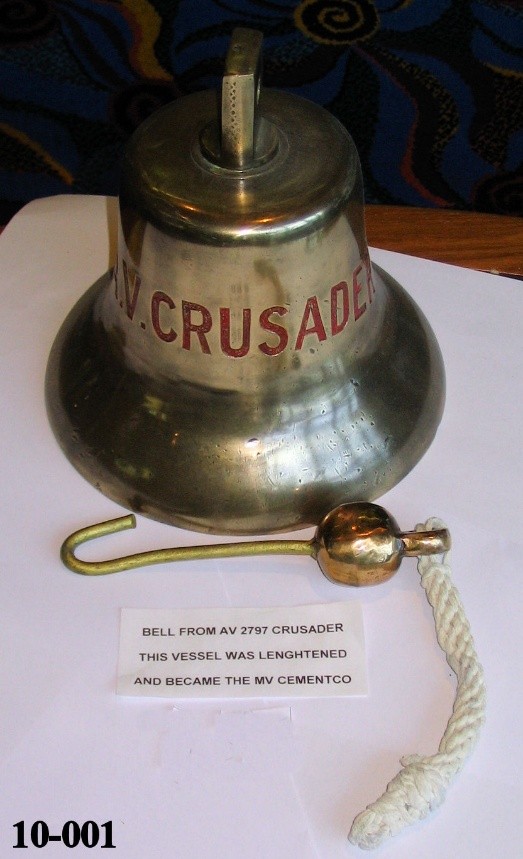
Ships Bell, Australian Army ship CRUSADER (AV 2767)

AV CRUSADER was a shallow draft heavy lift support ship launched late in 1945, too late to participate in WW2. She was used to return Australian Army equipment from the islands of New Guinea and then transport earth moving equipment and timber between Tasmania and the mainland. In 1947 AV CRUSADER was sold to the Queensland Cement and Lime Company and renamed CEMNTCO serving on the Brisbane River as a coral barge until being scuttled in 1986 to become a popular diving wreck.

Click here for further information.

To read an article about the Crusader Bell click here.

Collection – Maurice Avery Williams – (AHS Centaur)
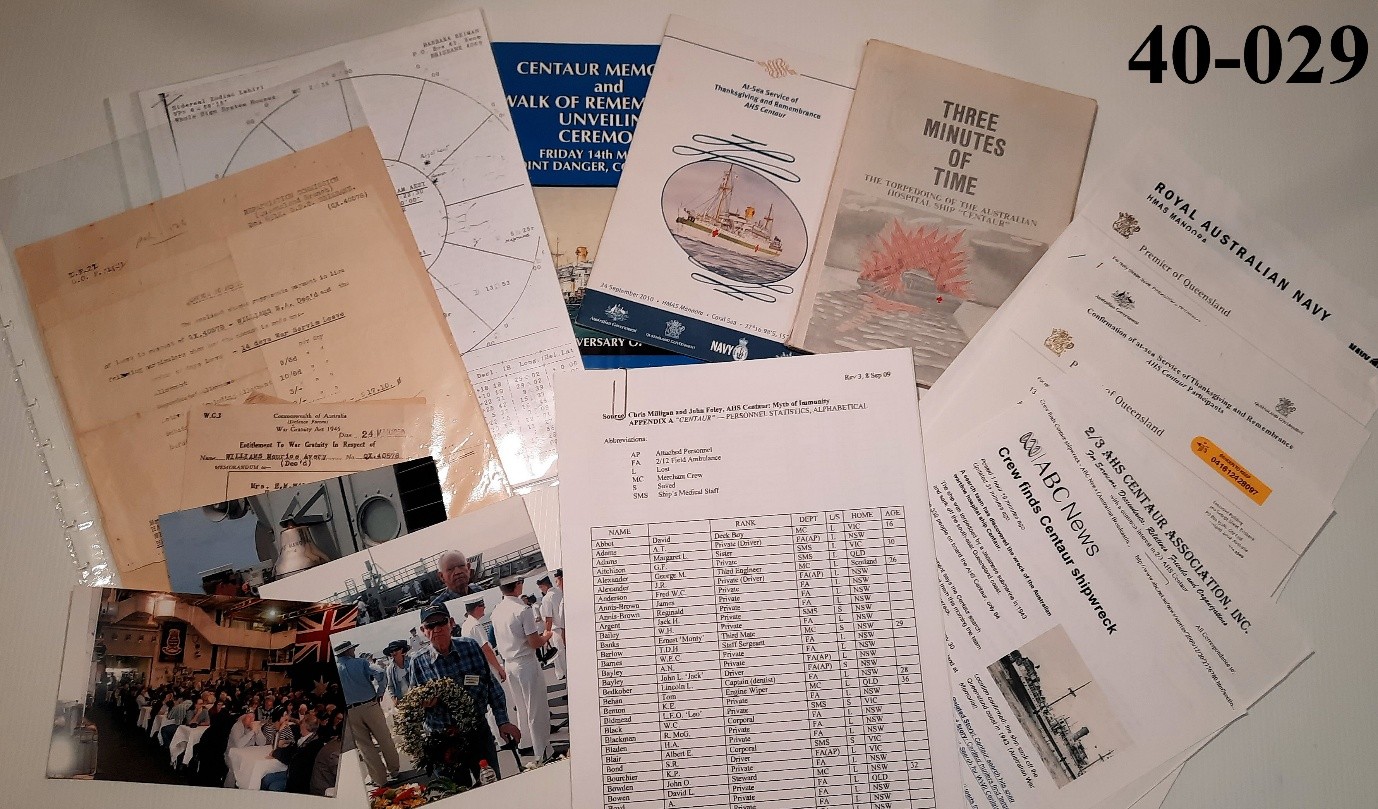
Maurice Williams, an Innisfail Ambulance Bearer with 20 years’ experience, enlisted in the Militia on the 2nd of Aril 1941 as a maturer aged enlistee because of his ambulance experience. He had several postings around Brisbane including employment as an ambulance trainer, gaining promotion to lance Sergeant and employment as the Regimental Aid Post (RAP) Sergeant, 2nd Camp Hospital, Chermside military camp. Maurice takes his discharge from the Milita and on the 30th of September 1942 and enlists in the AIF gaining promoted to Seargeant. In April 1943 Maurice is posted to the Australian Hospital Ship (AHS) Centaur and takes a reduction in rank to Corporal to be eligible for employment with the ships staff as all Sergeant positions on the ships staff have been filled. Maurice perishes when the AHS Centaur is torpedoed by a Japanese submarine to the East of Moreton Island, 14 May 1943 while on its first voyage from Sydney to Papua New Guinea to deliver Field Ambulance Soldiers and repatriate wounded. Click here to read more about Maurice Avery Williams story.

Donated by: Arnold and Moreen Williams

Belt – SENNIN-BARI

Means ‘thousand-person-stitches’ but usually translates into English as ‘thousand stitch belt’.

It is a piece of cloth about 6 inch by 31-39 inch covered with French knots stitched by 1000 women and worn by Japanese servicemen as a belt or sash to confer courage, good luck and immunity from injury. Only women were allowed to make them, and one woman could sew only one knot. It was common for the mother, sister, female relative or sweethearts of the soldier to stand in the streets or in the markets to ask the passers-by to sew a knot, which they did willingly.

Click here to read more about the SENNIN-BARI Belt story

Donated by: Colin Blatch

Photos – 455 Squadron RAAF in Russia 1942

In July 1942 convoy PQ17 transporting much needed material to the Russia port of Murmansk suffered 24 merchant ships sunk from a convoy of 32 ships along with three of the rescue ships.

Early in September 1944, 455 Squadron RAAF and 114 Squadron RAF flying Handley Page Hampden torpedo bombers deployed to Vaenga airfield near Murmansk to provide air support (Operation Orator) for convoy PQ18 passing through the North Sea to Murmansk. Several aircraft and crew were lost during transit from England to Russia. Operation Orator was considered a success when the convoy arrived in Russia with much reduced losses.

Due to heavy enemy activity and strong Westerly head winds, it was considered too dangerous to fly the aircraft back to England and surviving aircraft were donated to the Russians, along with some flight training. The main body of 455 Squadron personnel returned to England aboard HMS Argonaut in late October 1942 with the remaining squadron ground personnel returning in late November 1942 abord HMS Intrepid.

Number 455 Squadron was the only RAAF unit to have seen service in Russia during World War 2.

Click here to read the 455 Squadron story

Donated by Dr Oliver Squires

92-022

St Andrews Ex Serviceman’s Pipe Band Bass Drum Head

A funny thing happened in 1947. A chap called Field Marshall Montgomery visited Brisbane. Unfortunately, the army had demobilised to the point where they had no band in Brisbane at all to parade with.

The nearest thing was the St. Andrews Ex-Servicemen’s Pipe Band which just happened to have bought its uniforms from the 61st Battalion (The Queensland Cameron Highlanders). There was little chance Monty would know the difference, so the band was contacted and agreed to professionally misrepresent itself as an army band for the occasion – a simple enough ruse because they had all been servicemen a mere two years earlier. Some had even been under Monty’s command at El Alamein and wore the Africa Star among their decorations.

Monty duly inspected the band and asked if he could commemorate the occasion by signing the band’s bass drum. The bass drummer replied with normal Australian Army precision, “Aw yeah, I s’pose yer’ can if yer’ like mate” and fortunately Monty did like.

“Montgomery of Alamein, Field Marshall, 15/7/47”

The Drumhead is on loan from the St Andrew’s Pipe Band

Click here to read further information about the Signed Bass Drumhead

Jezaill Musket – Afghan Flintlock

Included in the weapons collection displayed in the upstairs foyer is a Jezail Musket.  Highly decorated and personalised, muzzle loading musket used by Arab fighters against British Empire forces in the First 1838-40 and second 1878-80 Anglo Afghan wars. Jezails saw continuous use by Arab fighters until the end of WW 1.

Photos ‘Military training Camp Chermside’ – Circa 1916.

The area of Marchants Paddock bounded by Gympie Road, Murphy Road and Ellison Road was used as the Military Training Camp Chermside during WW1. In 1917 George Marchant donated this land to the Kedron Shire in memory of those that served during WW1 and in May 1924 the Kedron Shire War Memorial gates were officially unveiled in Marchant Park.

Photos Show:

  • Members of the Sergeants Mess – 1916,
  • 1st ,2nd and 3rd Light Horse Signallers, in camp – 1916,
  • Hospital and Red Cross depot – 1916,
  • Distant View of Military Camp – 1916,
  • Camp Galleys and Dining Shelters – 1916,
  • A corner in Chermside camp – 1916,
  • YMCA building at Chermside Camp – 1916,
  • View from the Hospital, Chermside camp – 1916 and
  • Memorial Gates, Marchant Park, Chermside – Recent Photo

Donated by: Caloundra RSL Sub-Branch. Click here to see further photos of the Military Training Camp